How to Grow Cordyceps militaris in Jars
Cordyceps militaris cultivation in jars, day by day: liquid culture, rice and broth, dark then light, when to harvest, and keeping a culture line fruiting.
Cordyceps is Cordyceps militaris (family Cordycipitaceae), an ascomycete: orange clubs with no cap and no gills. It doesn't follow the other mushrooms here from grain spawn to a block. Liquid culture goes straight into a jar of brown rice and broth, and the same jar is where it fruits, once. A farm booklet from a USDA-funded SARE grant explains that it can live as a parasite or on dead matter, which is why it fruits on rice with no living host. This page follows it on a farm's clock, in jars; bins are a method it doesn't cover.
Cordyceps at a glance
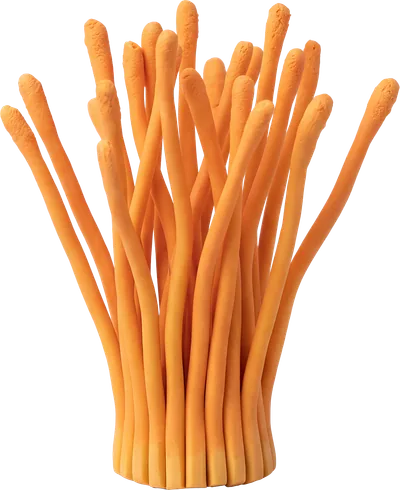
Fruiting
- Temperature
- 61 to 68 °F (16 to 20 °C)
- Humidity
- 80 to 90% relative humidity
- Light
- 12 hours a day
Incubation
- Temperature
- 64 to 70 °F (18 to 21 °C)
Practice
- Substrate
- Brown rice hydrated with a nutrient broth (yeast or peptone, a sugar or starch, minerals) in filter-lid jars, sterilized; the jar is also where it fruits
- Harvest when
- the orange clubs stop growing or reach the lid; in some strains the tips swell and turn bumpy
- To start fruiting
- move the colonized jar out of the dark into a cooler location with light on a daily timer; the lid and its filter stay on
From the published sources listed under Sources.
How long cordyceps takes to grow
A cordyceps jar is ready to harvest about 55 days after it is inoculated: in the dark while the rice colonizes, then about 40 days in light while the clubs grow. Before Day 0, the liquid culture that goes into the jar is made ready. These are the cultivation team's days, read as a jar; the stage names are proposed until the team sets a jar's own.
Before Day 0
Liquid culture ready
then culture firstDay 0
Jar made
rice and broth, sterilized, inoculated
then about 15 days darkabout Day 15
Light on
once the rice is colonized
then about 40 days lightabout Day 55
Harvest
one harvest a jar
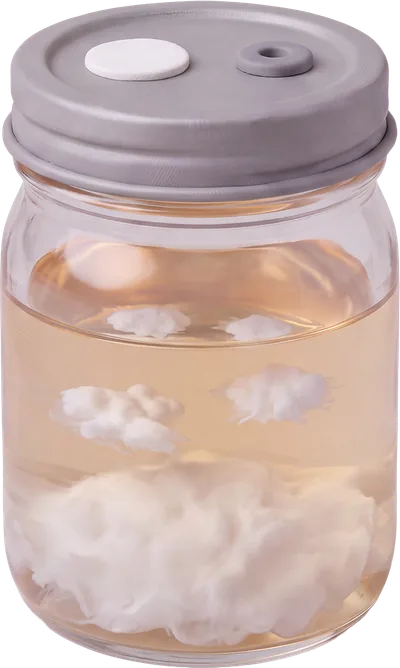
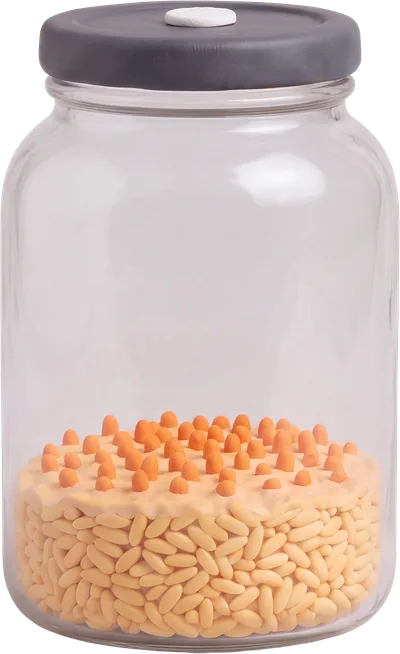
The cultivation team's days, read as a jar: a dark spell, then light. The stage names are proposed until the team sets a jar's own.
Published guides disagree on how long each spell takes; the sections below give their days. A farm's own jars vary with its strain and its locations.
In MycoQR, a farm records each jar as a block made from its liquid culture, with its own label, so the culture it came from, its dates and its harvest stay together: mushroom traceability by QR code.
Every mushroom's days, side by side: which mushrooms to grow.
Cordyceps substrate: brown rice and broth in a jar
Substrate: Brown rice hydrated with a nutrient broth (yeast or peptone, a sugar or starch, minerals) in filter-lid jars, sterilized; the jar is also where it fruits.
Each source makes its own nutrient broth and pours it over a shallow layer of brown rice. They agree on what goes in by kind (a protein or yeast source, a sugar or starch, and minerals) and differ on the rest. The sources sterilize their jars in a pressure cooker for 30 minutes to about 3 hours, then let them cool before inoculation.
A few milliliters of liquid culture go in through the filtered lid; the SARE farm used a wedge of an agar plate instead. There is no grain spawn stage: the SARE farm tried 5-pound bags of grain spawn, and they did not colonize well. Its trial report finds that "glass pint jars are still the best current container for production" (SARE report). In bags, colonization was slow or never came, and open pans all contaminated. Sterile work is in Mycology 102: sterile technique and culture work.
| Per jar | What the source uses | Source |
|---|---|---|
| Rice and broth | 28 g brown rice with 46 mL broth, pint jar | North Spore |
| 2 tablespoons of rice with a quarter cup of broth, wide-mouth pint | SARE booklet | |
| 20 g brown rice with 32 mL broth | Real Mushrooms | |
| 35 g brown rice with 70 mL broth (lab) | Hoang et al. 2024 | |
| Liquid culture | 1 to 2 mL through the lid filter | North Spore |
| 5 mL a container | Rootlab | |
| an eighth of an agar plate | SARE booklet | |
| Harvest, fresh | about 12 g a jar on average | SARE booklet |
| about 2 to 12 g a jar on average, by strain | SARE report | |
| about 10 to 45 g a kit container | Rootlab |
Fruiting cordyceps: the dark, then the light
The dark. Keep a new jar dark at 64 to 70 °F (18 to 21 °C) while the rice colonizes. Sources split on how long: Rootlab's kit guide puts its jars under light after 3 to 4 days, before the rice is white, while the SARE farm's spawn run took about 21 days for most strains (Rootlab, SARE booklet). North Spore names a white mold, Calcarisporium, that appears when inoculation temperatures rise above about 68 °F (20 °C): keep jars at the cool end.
To start fruiting, move the colonized jar out of the dark into a cooler location with light on a daily timer; the lid and its filter stay on.
| Fruiting | Cordyceps |
|---|---|
| Temperature | 61 to 68 °F (16 to 20 °C) |
| Humidity | 80 to 90% relative humidity |
| Light | 12 hours a day |
Light. Light turns the jar orange: Rootlab's kit guide notes that in light it changes from white to orange, and keeps its culture syringe dark for that reason. Sources split on the timer: ZombieMyco and the SARE farm trial run 12 hours on and 12 off, Rootlab runs 14, and the SARE booklet calls 16 ideal; none tests one against another (ZombieMyco, SARE report, Rootlab, SARE booklet). The SARE booklet notes that the clubs grow toward any light, so a shelf of jars wants a light on each layer.
The temperature ceiling. Heat ends a crop. In the SARE farm trial, "Temperatures spiked into the 80's and all pins were aborted. These jars never fruited." (SARE report). Sources set the ceiling in different places: Rootlab and Real Mushrooms hold it at 68 °F (20 °C), while the SARE booklet sets it at 80 °F (27 °C) and fruits at 60 to 70 °F (16 to 21 °C) (Rootlab, Real Mushrooms, SARE booklet). A temperature log on the fruiting location shows a spike before the jars do.
Humidity. The jar stays closed, so the humidity above is the location's air, not the jar's. The SARE booklet leaves the jar as it is and doesn't monitor humidity or fresh air while it fruits.
When to harvest cordyceps
Harvest when the orange clubs stop growing or reach the lid; in some strains the tips swell and turn bumpy.
Sources differ on when that comes: Real Mushrooms puts maturity at about 6 weeks from inoculation, Rootlab harvests after 60 days and not before 55, and the SARE farm trial harvested at 75 days (Real Mushrooms, Rootlab, SARE report). Rootlab also counts at least three clubs about 1½ in (4 cm) long or more, a sign it says isn't always reliable. The lid and its filter stay on until you harvest.
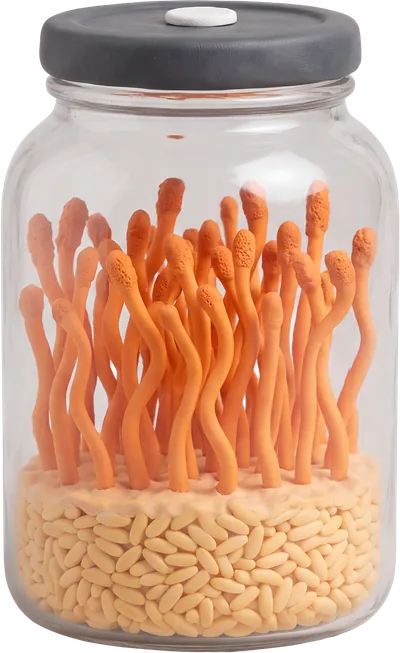
Ready to harvest
- Clubs no longer growing. Some strains also swell and turn bumpy at the tips.
- Clubs at full height, near the lid.
After the harvest
A jar gives one harvest: "Cordyceps is not typically fruited for a second time" (SARE booklet).
Drying. Sources dry the clubs at different temperatures: ZombieMyco at about 95 °F (35 °C), until crisp, and Real Mushrooms at about 131 °F (55 °C); neither compares the two (ZombieMyco, Real Mushrooms). The SARE booklet's dried clubs weighed about 13% of their fresh weight. Fresh, Rootlab's kit guide keeps them in the fridge for up to 3 days, in a zip-lock bag with a paper towel around them.
Keeping a culture line fruiting
A cordyceps culture can weaken as it is passed on. A line transferred plate to plate can lose its fruiting while the mycelium still grows: the jar colonizes, then gives few clubs or none. None of the grower pages we read covers it; the lab papers do.
When a line weakens. Most papers see the loss somewhere between the 2nd and the 6th transfer, though a transfer differs by paper: a spore generation in one, a plug moved to a new plate every two weeks in another.
| Study | What happened over transfers |
|---|---|
| Yin et al. 2017 | Degenerating from the 3rd generation, fruiting incomplete from the 4th, mycelium only by the 6th |
| Sung et al. 2006 | Fruiting stable to the 2nd to 6th subculture, then a sharp fall; strains older than about 18 to 20 weeks not advised for production |
| Vu et al. 2023 | Its own three strains declined from the 3rd generation, lost by the 5th |
| Wang et al. 2024 | One wild strain held its yield to the 11th generation |
| Wellham et al. 2021 | A line degenerated after 14 passages over two years |
How it shows. A 2021 review lists slower growth, paler mycelium, fewer pins, a longer cycle and misshapen clubs. A fading colony color is a sign: in Sung et al. 2006, the more a subculture's color moved from orange toward white, the fewer clubs it formed.
Why. Why a line weakens is still open; the papers point to mating types and stress.
How labs keep a line. The measures Wang et al. 2024 lists start with fewer transfers and storage at 39 °F (4 °C). For a farm, that means going back to a known-good stock kept cold rather than passing on a culture that was itself passed on, and counting each culture's transfers from that stock. Sun et al. 2018 kept strains able to fruit at that temperature for at least 12 months, and in Sung et al. 2006 strains still fruited well after 5 to 6 months. Wang et al. 2024 adds that none of these measures has done away with the problem.
Pick the strain. The SARE farm found strain selection extremely important, and only two of the five strains it tested fruited well. Inoculate in a still air box or at a flow hood.
What goes wrong
Jars that colonize but never fruit. The strain, or a tired line. In the SARE booklet, one strain left 17 of its 33 jars well colonized but without a club. Try another strain, or go back to the cold stock.
Pins that stop and die. Heat: a spike into the 80s °F (27 °C and up) aborted every pin in the SARE farm trial.
Twisted clubs, or none. Too warm: Rootlab's kit guide says that above 68 °F (20 °C), cordyceps deforms or doesn't grow.
White fuzz on top of the mycelium. Calcarisporium cordycipiticola, which North Spore names as a common contaminant of cordyceps; it appears when inoculation runs warm. A jar's own mycelium is white until the light turns it orange; this is fuzz growing over it. The contamination guide shows the molds.
Clubs leaning one way. Light from one side: cordyceps grows toward the light, so light each shelf evenly.
Questions
How long does cordyceps take to grow?
It takes about 55 days from inoculation on the cultivation team's days read as a jar: first in the dark, then about 40 days in light. The liquid culture is made ready before that.
Does cordyceps fruit more than once?
Not usually. A jar gives one harvest, and the sources don't fruit it a second time.
Why is my cordyceps still white?
Cordyceps turns orange in light, so a jar that stays white may not be getting enough. A culture that fades toward white over transfers is a sign the line is weakening.
Is cordyceps easy to grow?
A fair first grow only with sterile technique: every jar is sterilized and inoculated by hand, and the strain decides whether it fruits at all.Sources
Read in November 2026. The days in the grow calendar, and any card fact marked as the team's, are MycoQR's cultivation team's.
- SARE, farmer grant final report FNE18-890: Developing commercial cordyceps production
- SARE, farmer grant booklet by Fungi Ally: Cordyceps (2019)
- Sung et al. 2006, storage time and subcultures on fruiting: Mycobiology
- Yin et al. 2017, how a subcultured line degenerates: PLoS ONE
- Sun et al. 2018, storage and fruiting (abstract): World Journal of Microbiology and Biotechnology
- Kontogiannatos et al. 2021, a review of growing C. militaris: Journal of Fungi
- Wellham et al. 2021, a degenerated culture line: Microorganisms
- Vu et al. 2023, mating-type spore ratios and degeneration: Journal of Fungi
- Hoang et al. 2024, degeneration and osmotic stress: Scientific Reports
- Wang et al. 2024, mating-type imbalance in subcultures: PeerJ
- North Spore, blog: How to grow cordyceps mushrooms
- Real Mushrooms, blog: How to grow cordyceps mushrooms indoors
- Rootlab, kit guide: How to grow Cordyceps militaris
- ZombieMyco, blog: How to grow cordyceps mushrooms at home
Related guides
Mycology 102: Sterile Technique & Culture Work
Sterile technique, agar work and liquid culture: how to build a clean workspace, make reliable cultures and reduce contamination.
Building a Still Air Box
How to build a still air box (SAB) for mushroom culture work from a clear plastic tub: materials, cutting the arm holes, setup and mistakes to avoid.
Contamination Identification Field Guide
How to identify mushroom contamination: what green mold (Trichoderma), cobweb mold, black mold and bacteria look like, the likely source and what to do.