Golden Oyster Mushrooms: Escaped from Cultivation in North America
Golden oyster (yellow oyster) mushrooms escaped cultivation, and researchers call them invasive in North America. What's known and what growers can do.
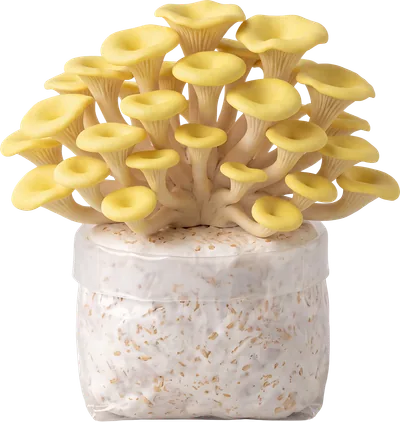
Golden oyster (Pleurotus citrinopileatus), also sold as yellow oyster, is a bright yellow oyster mushroom that grows in clusters. It is native to eastern Asia, where it decays dead hardwood, most often elm (WSL 2025). US culture collections held strains of it by the mid-1980s (Bruce 2018), and a 2025 study says it was imported into North America in the early 2000s and is now sold in popular grow kits (Veerabahu and others 2025).
It has also escaped, and the researchers who studied it in the wild call it invasive in North America (Veerabahu and others 2025). It has grown wild in North American forests since about 2010, and in dead elm trees where it grew, a 2025 field study found fewer fungal species, and different ones. This guide sets out what has been shown, what has been measured, what is not yet known, and what a farm that grows it can do.
- Shown
The wild golden oysters came from cultivated strains. Bruce 2018
- Measured
Fewer fungal species, and different ones, in dead elms where it grows. Veerabahu and others 2025
- Not yet known
What that change does to the forest. Stallman and Allen 2026
Is golden oyster invasive? What the research shows
Shown: the wild golden oysters came from cultivation. A 2018 master's thesis sequenced about 30 wild golden oysters collected in six states and compared them with cultivated strains. The wild samples closely matched two commercial strains, and their genetic groups did not follow geography, which the author read as several separate escapes and spread moved along by people (Bruce 2018).
Measured: in dead elms where it grows, there are fewer fungal species, and different ones. Researchers at the University of Wisconsin-Madison and the USDA Forest Service sampled fungi in dead elm trees in south-central Wisconsin. Where golden oyster was present, the mix of fungal species was significantly different and the number of species was significantly lower (Veerabahu and others 2025).
Not yet known: what that does to the forest. The study was one field survey of dead elm trees in one region, comparing trees with and without golden oyster. Whether it lowers native species everywhere or only in some places is an open question (Stallman and Allen 2026), and what it does to how dead wood breaks down has not been studied yet (Veerabahu 2026, Illinois Extension). Some in the trade question the word: an essay from the seller North Spore asks whether a shift in fungal communities "necessarily" means harm, while saying the study should not be dismissed (North Spore 2026). No method is known yet to limit its spread once it is in the woods (Invasive Species Centre).
Where golden oyster grows wild now
The 2025 study found it had spread in eight years to 25 US states and one Canadian province (Veerabahu and others 2025). The first wild record on Mushroom Observer, a public database of mushroom sightings, was photographed in Madison, Wisconsin, in June 2014 (Bruce 2018).
Sightings keep coming in. On November 12, 2026, iNaturalist held about 16,400 research-grade wild observations in the United States, most of them from Michigan, Wisconsin, Pennsylvania, Ohio, Iowa, Illinois, New York and Minnesota (iNaturalist). More people also log mushrooms on iNaturalist each year, so a rising count is not a clean measure of spread. In Canada, nearly all records are from Ontario. The study's model "predicts climate change will make many other parts of the continent climatically suitable" (Veerabahu and others 2025).
By the mid-1980s
US culture collections hold strains of golden oyster. Bruce 2018
Early 2000s
Imported into North America for growing, and later sold in grow kits. Veerabahu and others 2025
About 2010
Escapes into North American forests. Veerabahu and others 2025
June 2014
The first wild record on Mushroom Observer, in Madison, Wisconsin. Bruce 2018
2018
A genetic study matches wild samples to commercial strains. Bruce 2018
2025
A field study finds fewer and different fungi in dead elms where it grows, and counts it in 25 states and one Canadian province. Veerabahu and others 2025
August and September 2025
Wisconsin's and Michigan's natural resources departments publish warnings, and Field & Forest suspends golden oyster block sales. Wisconsin DNR 2025, Michigan DNR 2025, Field & Forest 2025
November 2026
About 16,400 research-grade wild observations in the United States on iNaturalist. iNaturalist
How golden oyster escaped cultivation
No one knows the exact route. Kits grown at home, farms and outdoor logs are all possible (Veerabahu 2025, The Conversation). The genetic study points to more than one escape, from closely related strains, and thought outdoor growing the likeliest route without showing it (Bruce 2018).
Two things can carry it out: spores, and living mycelium in spent blocks, logs and kits (Invasive Species Centre; Veerabahu 2026, Illinois Extension). A golden oyster left to mature releases "copious numbers of whitish-pink spores" (Bruce 2018), and Wisconsin's Department of Natural Resources warns that spores from cultivated golden oysters "will be carried by air to nearby forests" (Wisconsin DNR 2025).
Is it illegal to grow golden oyster?
In our search in November 2026 we found no US state or Canadian province that lists golden oyster as a prohibited or restricted species. Michigan's Department of Natural Resources has asked home growers to consider not using golden oyster kits, and asked sellers to say it is invasive and should be "cultivated indoors and not composted" (Michigan DNR 2025). Hawaii requires a permit to import any Pleurotus species not already reported there (Stallman and Allen 2026). Rules can change, so check your own state or province.
Some sellers have stopped on their own. As of November 2026, North Spore has discontinued its golden oyster products except cultures, "due to growing concern around naturalization," and says it is working with researchers on a sporeless strain (North Spore). Field & Forest Products "suspended the sales of Golden oyster blocks until we can gather more information" and reports a spore-less strain in development (Field & Forest 2025). Neither had a sporeless golden oyster for sale when we checked.
If you grow it now
The growers on MycoQR's cultivation team grew golden oyster indoors only, and have stopped producing it. One of their farms, Circular Harvest, writes: "Responsible cultivation practices and proper disposal of grow kits are essential to prevent further outbreaks." Others still grow it, and the steps below are written for them: what researchers, agencies and sellers recommend, with who says each one, and one suggestion of ours, marked as ours. None has been tested as a way to keep golden oyster out of the woods.
Grow it indoors only. No outdoor logs, beds or outdoor fruiting (Michigan DNR 2025; Stallman and Allen 2026). Indoor growing has not been shown to hold the spores in, so indoors is the least that is asked, not a guarantee.
Pick it young. Harvest into a closed container, such as a lidded tote, before the caps mature and drop their spores (FUNDIS 2025; Stallman and Allen 2026).
Kill the mycelium in spent blocks before they leave the farm. Writing about home kits, Stallman and Allen suggest heat (an oven above 302 °F (150 °C) for more than an hour), pasteurizing or pressure cooking (Stallman and Allen 2026), and the Invasive Species Centre suggests sealing used kits in plastic and leaving them in the sun before they go out with the trash (Invasive Species Centre). Our suggestion for a farm: run spent blocks back through your own pasteurizer or sterilizer, then send them to the landfill. Michigan's DNR and the Invasive Species Centre say not to compost them (Michigan DNR 2025; Invasive Species Centre), while Field & Forest and Switzerland's forest institute suggest breaking blocks up before composting (Field & Forest 2025; WSL 2025). Either way, keep them out of the woods.
Keep a record of where each batch's spent blocks went, and of the culture it came from. The 2018 genetic study could name only "possible source strains" for the wild population (Bruce 2018). A farm that writes down where its culture came from and where its spent blocks went has an answer if a buyer, a market or a researcher asks. In MycoQR, mushroom traceability starts at the block: its record goes back to the culture it came from and keeps the day it moved to Spent Block, and a note on its batch can say where the spent blocks went.
Researchers and agencies suggest native mushrooms. Wisconsin's DNR says "it is encouraged to cultivate native mushrooms" (Wisconsin DNR 2025), and the study's lead author suggests growing local varieties (Veerabahu 2026, Illinois Extension). The Fungal Diversity Survey names native oysters such as Pleurotus ostreatus and Pleurotus pulmonarius, cultivated from local specimens (FUNDIS 2025). See how to grow oyster mushrooms for the oysters MycoQR's guides cover.
Golden oyster look-alikes
Wild golden oysters can be mistaken for the toxic jack-o'-lantern (Omphalotus illudens), which is more orange than yellow, and for honey mushrooms (Armillaria mellea) (Invasive Species Centre). Never eat a wild mushroom you haven't had identified by someone who knows it.
If you find it in the woods
Report it to iNaturalist or EDDMapS, with a photo and the place (Invasive Species Centre; Michigan DNR 2025).
Questions
Can I still grow and sell golden oyster? We found no state or province that restricts it as of November 2026; see Is it illegal to grow golden oyster? above, and check your own rules.
Is golden oyster edible? Yes. Researchers describe it as a "widely cultivated and edible fungus" (Veerabahu and others 2026, World Biodiversity Forum). This guide is about where it grows, not about eating it.
Is golden oyster the same as yellow oyster? Yes. Both names are sold for Pleurotus citrinopileatus.
Is golden oyster invasive everywhere? The evidence on this page is from North America. Switzerland's federal forest research institute does not yet class it as invasive there, because it has been found in the wild there too rarely and no harm to native fungi has been shown there; it says it must be considered invasive in North America (WSL 2025).
Sources
- Bruce 2018: Bruce, A. L. Population genomic insights into the establishment of non-native golden oyster mushrooms (Pleurotus citrinopileatus) in the United States. Master's thesis, University of Wisconsin-La Crosse.
- Veerabahu and others 2025: Veerabahu, A., Banik, M. T., Lindner, D. L., Pringle, A., and Jusino, M. A. "Invasive golden oyster mushrooms are disrupting native fungal communities as they spread throughout North America." Current Biology 35 (16): 3994 to 4002. This guide uses the paper's abstract.
- Veerabahu 2025, The Conversation: the study's lead author on the study, July 16, 2025.
- Veerabahu 2026, Illinois Extension: the study's lead author on what is still unknown, May 14, 2026.
- Veerabahu and others 2026, World Biodiversity Forum: conference abstract WBF2026-557.
- Stallman and Allen 2026: Stallman, J. K., and Allen, J. L. "What should we do about cultivated mushroom invasions?" Studies in Fungi 11: e010.
- WSL 2025: Auf der Maur, B., Brännhage, J., Oggier, A., and Gross, A. Der Zitronenseitling und die Risiken verwilderter Zuchtpilze, Swiss Federal Institute for Forest, Snow and Landscape Research, October 3, 2025.
- Wisconsin DNR 2025: "Golden Oyster Mushrooms Aren't Friends To Native Fungi", Wisconsin DNR Forestry News, August 1, 2025.
- Michigan DNR 2025: "Popular golden oyster mushrooms now invading Michigan forests", Michigan Department of Natural Resources, August 5, 2025.
- Invasive Species Centre: "Golden Oyster Mushroom", read November 12, 2026.
- FUNDIS 2025: Fungal Diversity Survey, "Help us keep golden oysters out of native fungi habitat", January 30, 2025.
- Circular Harvest: "Invasive Species: Golden Oyster Mushrooms", a farm's blog, read November 13, 2026.
- North Spore: golden oyster collection page, read November 12, 2026.
- North Spore 2026: "Rethinking 'Invasive'", May 11, 2026.
- Field & Forest 2025: "What we know about the invasive nature of Golden oyster", Field & Forest Products, September 12, 2025.
- iNaturalist: wild research-grade observations of Pleurotus citrinopileatus in the United States, counted November 12, 2026, with the state counts read through GBIF.
Related guides
How to Grow Oyster Mushrooms
How to grow oyster mushrooms: seven types compared day by day, straw or sawdust, fruiting conditions, when to harvest, and what goes wrong.
Fruiting Chamber Designs
Two mushroom fruiting chamber designs for growers scaling up, a Martha tent and a dedicated fruiting room: how each works and who it suits.
Mycology 104: Environmental Control & Fruiting
How to set up fruiting conditions: fresh air exchange, humidity, temperature and light, then when to harvest and how to manage flushes.