How to Grow Enoki Mushrooms
How to grow enoki mushrooms (Flammulina filiformis, long sold as F. velutipes) day by day: the substrate, the cold start, the sleeve and when to harvest.
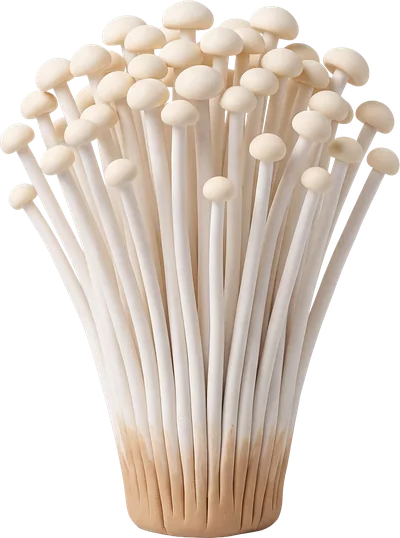
Enoki is Flammulina filiformis (family Physalacriaceae), long sold as F. velutipes: clusters of thin stems under small round caps, grown on sawdust. The thin white enoki sold in shops is a white strain grown cold and dim in collared bottles. Grown warmer and in more light, it gives a short stem and a darker cap. Golden strains are sold too, and Out-Grow says golden and white grow on the same supplemented sawdust. Enoki is a cold mushroom: it pins in a cool room and grows its long stems colder still. This page follows it on a farm's clock, from the culture to the second harvest, on blocks in bags whose walls stand as a sleeve around the stems.
Enoki at a glance
Fruiting
- Temperature
- 50 to 64 °F (10 to 18 °C)
- Humidity
- 90 to 95% relative humidity
- Fresh air
- CO2 under 3,000 ppm
- Light
- 12 hours a day
Incubation
- Temperature
- 66 to 75 °F (19 to 24 °C)
- Spawn rate
- 5 to 10% of the wet substrate's weight
Harvests
- Flushes worth picking
- 2 to 3
Practice
- Substrate
- Hardwood or conifer sawdust with about 20% rice or wheat bran (farms also use corncob mixes), at about 60 to 65% water, sterilized in bags or bottles
- Opening the bag
- Open the top and leave the bag walls standing as a sleeve, or fit a paper or plastic collar once the stems stand about an inch above the opening.
- Harvest when
- the stems are long and the caps are still small and closed, before they open or flatten. Take the whole cluster at once
- To start fruiting
- scratch the top of the fully colonized block, then move it to a cold, very humid room. Some kit sellers suggest a night or two in the fridge first
Fruiting temperature, humidity, fresh air, light, incubation temperature and flushes worth picking are the cultivation team's own. The rest come from the published sources listed under Sources.
How long enoki mushrooms take to grow
An enoki block gives its first harvest on about day 27 after it is inoculated and its second on about day 41. Before that, the grain spawn takes about 18 days, and before the grain a new culture takes about 14 days, on agar or in liquid culture: about 59 days from a new culture to the first harvest. A farm with a culture on hand starts at the grain spawn, and one that buys its grain spawn starts at Day 0. Published guides disagree on how long each stage takes; these are the days MycoQR's cultivation team set.
about 32 days before
Agar or liquid culture
inoculated
then about 14 daysabout 18 days before
Grain spawn inoculated
from the culture
then about 18 daysDay 0
Block inoculated
with the colonized grain
then about 15 daysabout Day 15
Colonized
scratch the top, then move it cold
then about 12 daysabout Day 27
First harvest
then about 14 daysabout Day 41
Second harvest
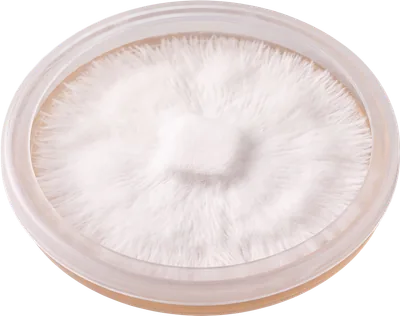
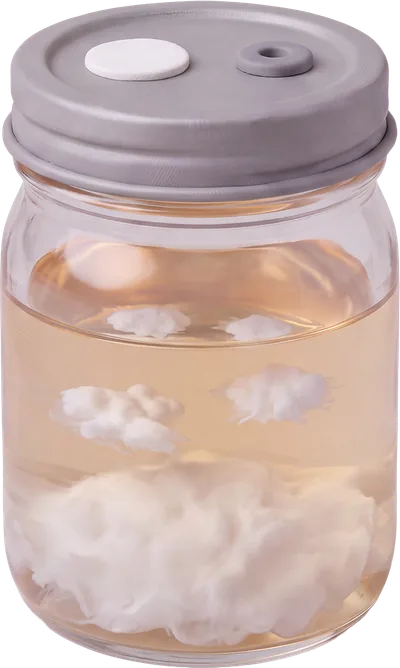
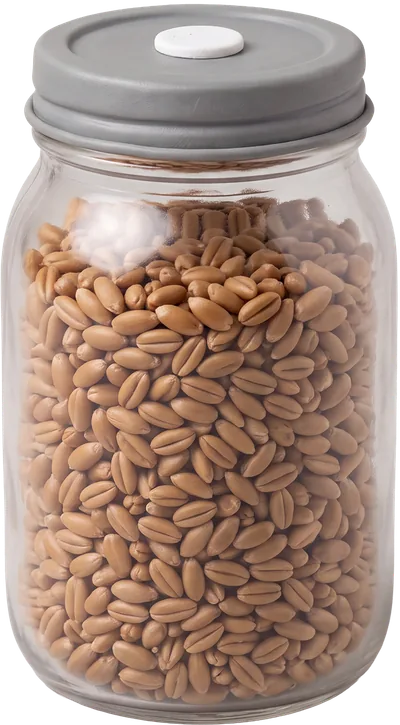
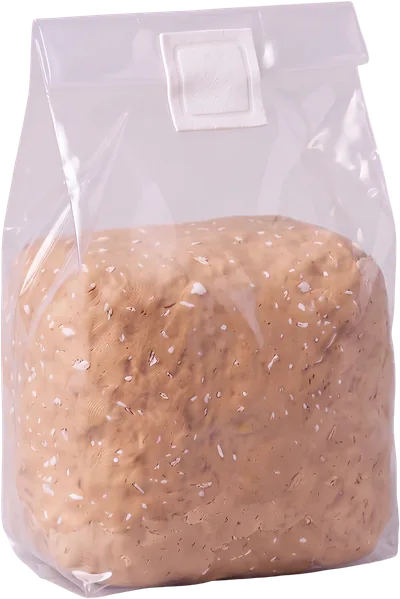
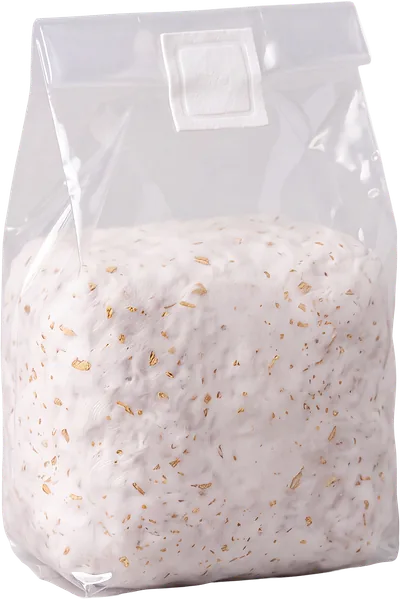
A colonized block can wait up to about 30 days at room temperature, or about 90 in cold storage, before you open it.
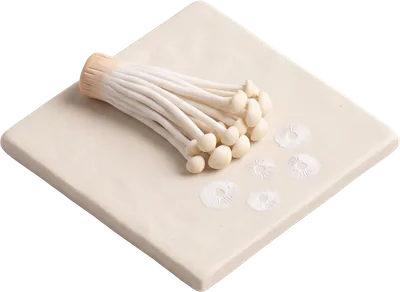
The strip starts from a culture. From a spore print, spores germinate on agar first and one strain is picked out before the culture step. Each spore start is new genetics, while a tissue culture keeps its parent's.
A farm's own blocks run faster or slower with its strain and its rooms. In MycoQR, a farm's enoki strain starts on the calendar's days, and once the strain has enough harvests of its own, its own days to first harvest take over.
Every mushroom's days, side by side: which mushrooms to grow.
Enoki substrate and spawn
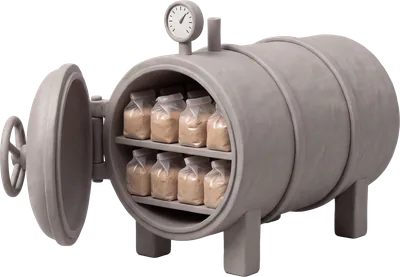
Substrate: Hardwood or conifer sawdust with about 20% rice or wheat bran (farms also use corncob mixes), at about 60 to 65% water, sterilized in bags or bottles.
Spawn rate: 5 to 10% of the wet substrate's weight.
Sources differ on the rate: GroCycle gives 5 to 10% grain spawn to the wet substrate, while Out-Grow puts 1 lb of grain spawn in a 5 lb block, about 20% (GroCycle, Out-Grow). Supplemented sawdust is sterilized, not pasteurized: the bran feeds the mushroom but also raises the risk of contamination. Making and sterilizing blocks is in Mycology 103: substrate science and spawn production.
Colonizing
Keep blocks at 66 to 75 °F (19 to 24 °C) in the dark while they colonize.
Keep the room from running warm: Out-Grow warns that temperatures above 79 °F (26 °C) can slow colonization and favor contamination.
On the calendar above, a block colonizes in about 15 days. Enoki needs no ripening after that: Japan's Nagano Prefecture growing sheet scratches a bottle right after it colonizes. A colonized block can wait up to about 30 days at room temperature, or about 90 days in cold storage, before you start it fruiting.
Fruiting enoki mushrooms: growing conditions
Opening the grow bag: Open the top and leave the bag walls standing as a sleeve, or fit a paper or plastic collar once the stems stand about an inch above the opening.
To start fruiting, scratch the top of the fully colonized block, then move it to a cold, very humid room. Some kit sellers suggest a night or two in the fridge first.
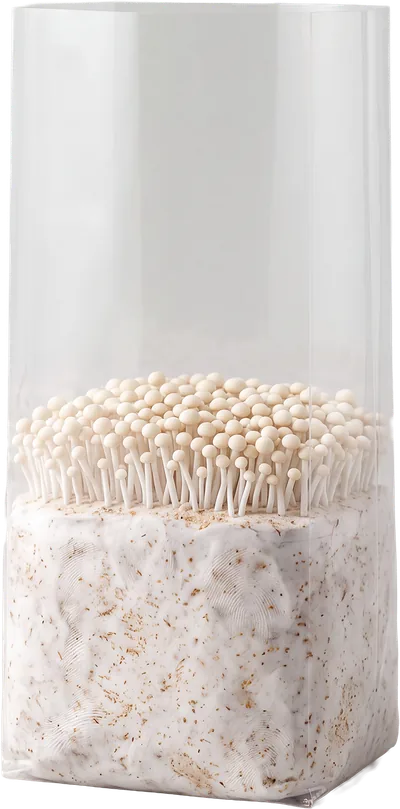
Pins on top
- The bag's walls left standing as a sleeve.
- Pins across the scratched top.
| Fruiting | Enoki |
|---|---|
| Temperature | 50 to 64 °F (10 to 18 °C) |
| Humidity | 90 to 95% relative humidity |
| Fresh air | CO2 under 3,000 ppm |
| Light | 12 hours a day |
Pins want the air wetter still: GroCycle holds 95 to 100% humidity while they form, then 85 to 95%.
The cold. Enoki pins in a cool room and grows its long stems colder still. Bottle farms pin at about 50 to 59 °F (10 to 15 °C), then grow the stems colder, 37 to 46 °F (3 to 8 °C). A bag fruited warmer, or in more light, gives a shorter enoki with a darker cap. Out-Grow finds that blocks held above 68 °F (20 °C) don't pin.
Scratch, then cold. Bottle farms scrape the top of the colonized substrate, then move it to the pinning room. In a 2023 Chinese bottle trial (Li et al.), untreated bottles pinned on day 12 with 47 pins; scratched, cooled, or both, they pinned on day 5 or 6. Scratching alone gave 757 pins a bottle, both together 1,859, cooling alone 22. Some kit sellers chill the block first: GroCycle's suppliers recommend a night in the fridge before the bag is opened, and Zombie Mushrooms gives 48 hours near 40 °F (4 °C).
The sleeve. The collar or the bag's tall walls help make enoki long, with the cold and the dim light: they hold the cluster upright and trap still air around the stems. Sources split on how much fresh air the room needs: Japan's Nagano Prefecture growing sheet keeps CO2 low and warns that holding it high to check the caps misshapes the mushrooms, while Out-Grow and Mycelia hold it high to keep the caps small (Nagano, Out-Grow, Mycelia).
Light. Keep enoki dim: short spells of low light, under an hour a day. More light gives thicker stems and darker caps.
Each condition is explained in Mycology 104: environmental control and fruiting, and fruiting chamber designs shows ways to hold them.
When to harvest enoki mushrooms
Harvest when the stems are long and the caps are still small and closed, before they open or flatten. Take the whole cluster at once.
Out-Grow picks while the caps are under 1 in (2.5 cm) across. Shop enoki, in a Korean bottle study, has caps of ⅜ in (1 cm) or less on stems of 4 to 5½ in (10 to 14 cm). Cut the cluster at its base with a clean, sharp knife: Out-Grow warns that pulling or twisting tears out substrate and reduces the next flush.
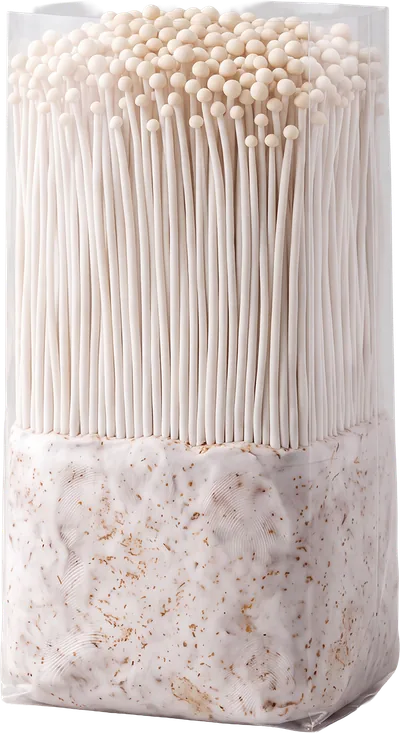
Ready to harvest
- Caps small and closed: pick before they open.
- The bag's walls hold the stems upright.
- Cut the whole cluster at its base.
After the harvest
On the calendar above, the next flush is ready about 14 days after a harvest. A block gives 2 to 3 flushes worth picking. The bottle farms in the sources take one harvest a bottle; bag and kit growers take more. Before the next flush, Mycoboutique puts its kit bag in the fridge, at 34 to 39 °F (1 to 4 °C), for 2 days.
A fresh harvest keeps about 5 days. Out-Grow refrigerates enoki within a few hours of picking, at 32 to 39 °F (0 to 4 °C), in a loosely closed perforated bag.
In MycoQR, a new yield tray (the harvests you combine to sell) suggests a best-by date about 5 days out, and the Fresh Sheet marks a tray that is past it: mushroom farm inventory and invoicing.
The CDC, in its notice on a listeria outbreak linked to enoki, says: "Restaurants should cook enoki mushrooms thoroughly before serving to customers" (CDC).
Storing cultures and spawn
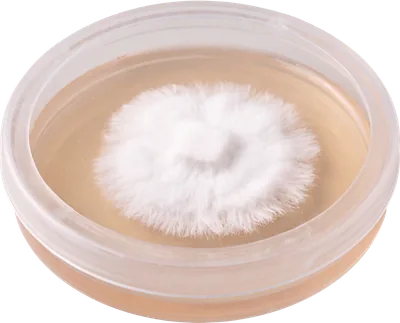
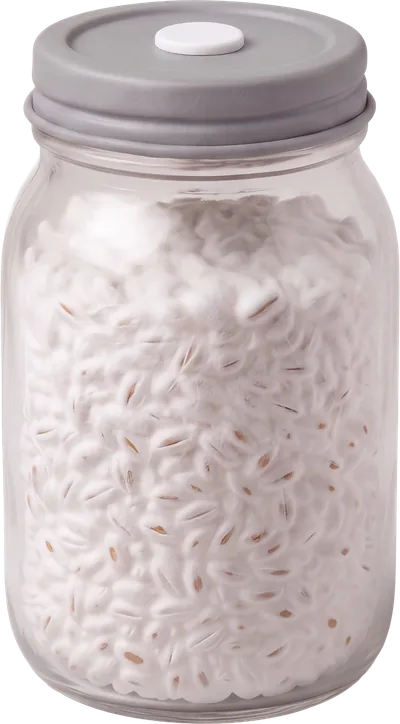
On the cultivation team's answers, cold storage extends the life of enoki plates, liquid culture, grain spawn and colonized blocks, and does nothing for spores. The days below are the team's. Storing cultures is in Mycology 102: sterile technique and culture work.
| Finished | Room temperature | Cold storage |
|---|---|---|
| Agar plates | about 30 days | about 90 days |
| Liquid culture | about 60 days | about 120 days |
| Grain spawn | about 45 days | about 90 days |
| Colonized blocks | about 30 days | about 90 days |
Cold storage is cold enough to start enoki pinning: check stored blocks often, and start fruiting any that show pins.
What goes wrong
No pins. The room is too warm, the surface dried out, or the top wasn't scratched. Out-Grow's fix for a colonized block that won't pin at 60 to 65 °F (16 to 18 °C) is a real cold room, 45 to 57 °F (7 to 14 °C), with the humidity raised to 95%. For a block that still won't fruit, see no pins forming in Common Fruiting Problems.
Short, thick stems and wide, brown caps. Too much light, too warm, or too little still air around the stems. Out-Grow reads short, thick stems with wide caps as too little CO2 while the stems lengthen, or too much light. Keep the sleeve up, the light dim and the room cold.
Slimy, spotted caps. Out-Grow ties them to too much humidity with too little airflow, and drops the humidity to 90 to 93%.
Rot or mold in the cold room. Nagano's disease database names two cold-room problems that spread on the scratching blade: a bacterium that rots the cluster base black with a syrupy liquid, carried in humidifier mist and condensation, and a white, cottony mold that is easy to miss on white enoki. Sterilize the blade, and keep humidifiers and coolers clean.
Green mold. Out-Grow notes that Trichoderma often starts as white, fluffy growth that can blend with enoki's fine white mycelium. The contamination guide shows the molds.
Questions
Is Flammulina velutipes the same as enoki?
Cultivated enoki is Flammulina filiformis. It was long sold as F. velutipes, and many spawn sellers still use that name, but F. velutipes is now the name of a separate species.
Do enoki mushrooms need light?
Very little. Short spells of low light are enough, and the dimmer the room, the longer and whiter the stems.
How long do enoki mushrooms take to grow?
It takes about 59 days from a new culture to the first harvest, or about 45 days from the grain spawn, on the days MycoQR's cultivation team set. Counted from the day the block is inoculated, the first harvest comes on about day 27.
Can you regrow store-bought enoki?
Only by culturing a piece of stem base on a sterile medium; bought spawn or a kit is more reliable.
Is enoki easy to grow?
Typically top fruited in high co2 environments however can be top or side fruited with a small slice or an xSources
Read in November 2026. The days in the grow calendar and the storage table, and any card fact marked as the team's, are MycoQR's cultivation team's.
- Penn State, specialty mushrooms: Production technology
- Nagano Prefecture, enoki growing sheet (Japanese): エノキタケ栽培のポイント
- Nagano Prefecture, mushroom pest and disease database (Japanese): きのこ病害虫データベース(菌茸部)
- Japan Ministry of Agriculture, Forestry and Fisheries, variety test guideline (Japanese): えのきたけ審査基準
- CDC: Listeria Outbreak Linked to Enoki Mushrooms
- Kim et al. 2015, a brown enoki cultivar grown in bottles (Korean): Journal of Mushrooms
- Lee et al. 2023, a brown enoki cultivar on a corncob mix (Korean): Journal of Mushrooms
- Li et al. 2023, scratching and cold to start pins: Frontiers in Microbiology
- GroCycle: The ultimate guide to enoki mushrooms
- Out-Grow: How to grow enoki mushrooms (Flammulina velutipes)
- North Spore, kit: Organic golden enoki fruiting block
- Mycelia, strain sheets for Flammulina velutipes: M4600, orange-yellow, M4622, white
- Mycoboutique, kit sheet: Enoki (Flammulina velutipes) cultivation
- Zombie Mushrooms: Enoki mushrooms cultivation
Related guides
How to Grow Nameko Mushrooms
How to grow nameko mushrooms (Pholiota microspora, sold as P. nameko) day by day: the substrate, a cool, humid fruiting room, whether to chill, and harvest.
How to Grow Beech Mushrooms (Shimeji)
How to grow beech mushrooms (shimeji), brown or white, on blocks day by day: the weeks of ripening, a cool, very humid room and when to harvest.
Common Fruiting Problems and How to Fix Them
Diagnose and fix the most common fruiting problems: no pins, aborting pins, long stems, fuzzy feet, overlay, cracked caps and bacterial blotch.