How to Grow King Oyster Mushrooms
How to grow king oyster (king trumpet) mushrooms day by day: Pleurotus eryngii from the top of the bag, a cool room, the CO2 that shapes the stem, and harvest.
King oyster, also sold as king trumpet, is Pleurotus eryngii (family Pleurotaceae): a thick, white, meaty stem under a small tan to grey-brown cap. It is an oyster, in the same genus as blue and pink, but a species of its own, and it grows another way: upright and singly from the top of the block, not in shelves from the side. It is native to the Mediterranean, the Middle East and North Africa, where, Mycelia writes, it lives on the weakened roots of Eryngium and Carduus plants, and not to the US. This page follows it on a farm's clock, from the culture to the second harvest, on blocks in bags. What all oysters share is in the oyster mushroom guide.
King oyster at a glance
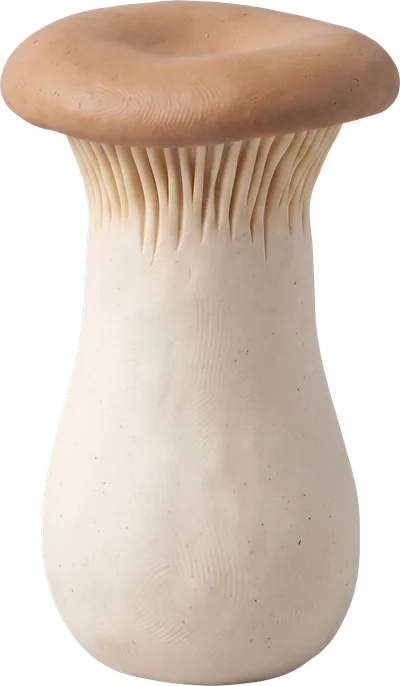
Fruiting
- Temperature
- 54 to 64 °F (12 to 18 °C)
- Humidity
- 90 to 95% relative humidity
- Fresh air
- CO2 under 2,000 ppm
- Light
- 12 hours a day
Incubation
- Temperature
- 68 to 75 °F (20 to 24 °C)
- Spawn rate
- 2 to 5% of the wet substrate's weight
Harvests
- Flushes worth picking
- 1 to 2
Practice
- Substrate
- Masters mix works well
- Opening the bag
- King oysters have success fruting from the top or side of the bag. a small slit or X on the side or cut top off bag a few inches above the substrate.
- Harvest when
- When fruit is still firm and go=rowth has slowed down.
- To start fruiting
- move the colonized block to the cooler fruiting room and make a small cut in the bag top. Keep humidity very high until pins form, then give more air
Fruiting temperature, humidity, fresh air, light, incubation temperature, flushes worth picking, substrate, opening the bag and harvest when are the cultivation team's own. The rest come from the published sources listed under Sources.
How long king oyster mushrooms take to grow
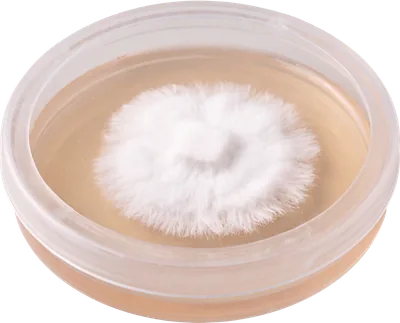
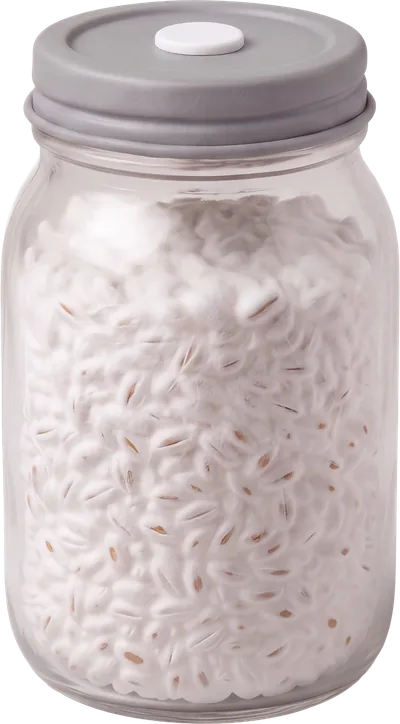
A king oyster block gives its first harvest on about day 28 after it is inoculated and its second, on a block that gives one, on about day 42. Before that, the grain spawn takes about 14 days, and before the grain a new culture takes about 14 days, on agar or in liquid culture: about 56 days from a new culture to the first harvest. A farm with a culture on hand starts at the grain spawn, and one that buys its grain spawn starts at Day 0. Published guides disagree on how long each stage takes; these are the days MycoQR's cultivation team set.
about 28 days before
Agar or liquid culture
inoculated
then about 14 daysabout 14 days before
Grain spawn inoculated
from the culture
then about 14 daysDay 0
Block inoculated
with the colonized grain
then about 14 daysabout Day 14
Colonized
open the bag to fruit
then about 14 daysabout Day 28
First harvest
then about 14 daysabout Day 42
Second harvest
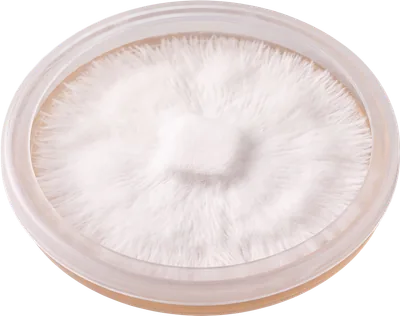
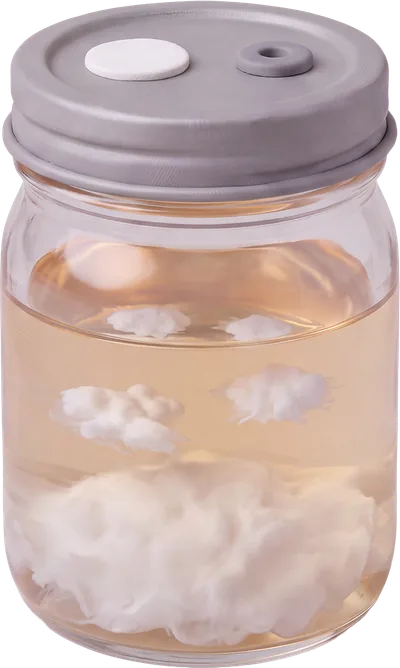
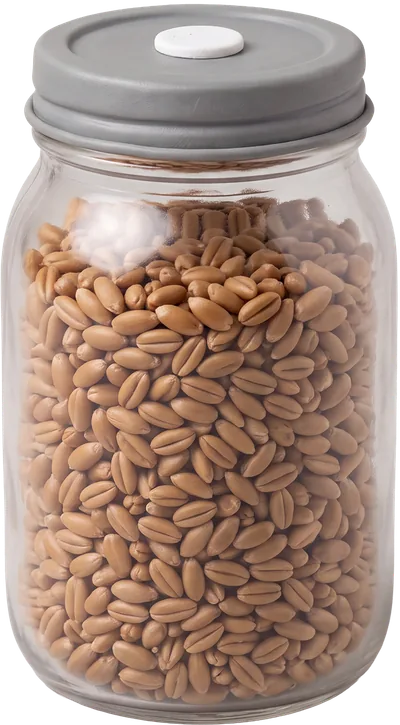
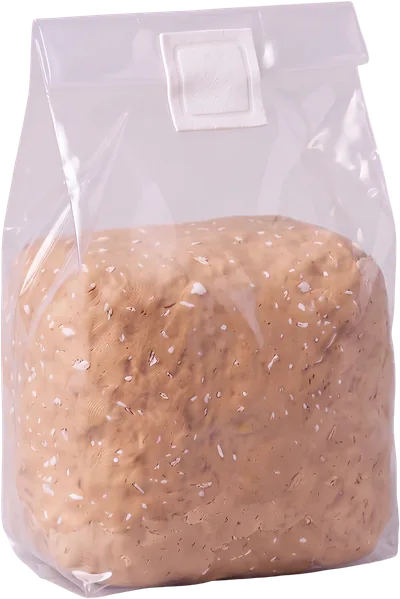
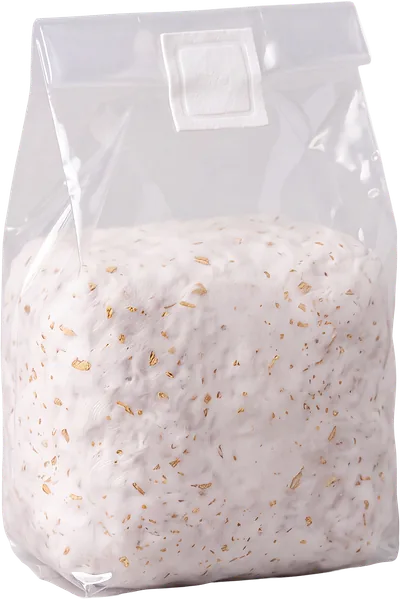
A colonized block can wait up to about 30 days at room temperature, or about 60 in cold storage, before you open it.
The strip starts from a culture. From a spore print, spores germinate on agar first and one strain is picked out before the culture step. Each spore start is new genetics, while a tissue culture keeps its parent's.
A farm's own blocks run faster or slower with its strain and its rooms. In MycoQR, a farm's king oyster strain starts on the calendar's days, and the strain's own stage times and harvests take over once there are enough of them.
Every mushroom's days, side by side: which mushrooms to grow.
King oyster substrate and spawn
Substrate: Masters mix works well.
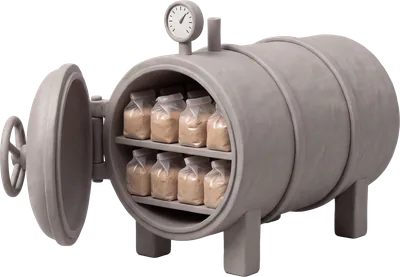
Spawn rate: 2 to 5% of the wet substrate's weight, in sterilized bags.
King can fruit on pasteurized straw, but growers who use straw fill and spawn it bag by bag, and plain straw yields less than mixes; Out-Grow advises against plain straw on its own. Most farms use supplemented sawdust, sterilized, not pasteurized, because of the supplement. How each substrate is prepared is in substrate methods in the oyster mushroom guide and Mycology 103: substrate science and spawn production.
Which king. Strains differ in stem and cap size and in how well they resist bacterial infection. North Spore's Black King is another mushroom: its booklet calls it a "Hybrid of oyster and king trumpet" (North Spore). Ask the spawn maker which you're buying.
Colonizing
Keep blocks at 68 to 75 °F (20 to 24 °C) while they colonize.
On the calendar above, a block colonizes in about 14 days. Sources disagree on how long: grower guides and Mycelia give 10 to 21 days, while a New York farm's blocks took 28 to 30 days and two Korean bottle farms incubated 30 and 45 days (GroCycle, Out-Grow, Mycelia, M2600, SARE, Kim et al. 2019). Spawn rate moves it too: GroCycle notes that a higher rate colonizes faster, and Out-Grow counts a rate under 5% among the causes of a slow run.
A colonized block can wait up to about 30 days at room temperature, or about 60 days in cold storage, before you open it.
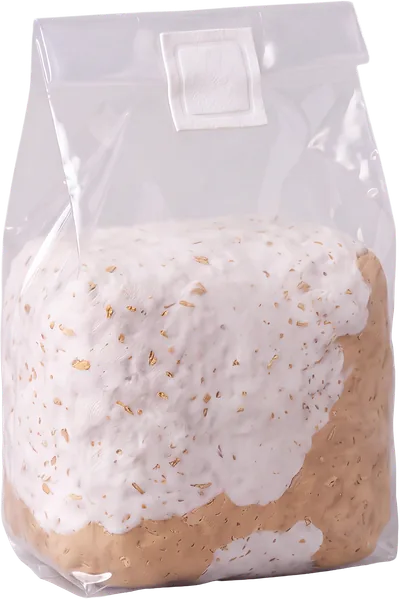
Fruiting king oyster mushrooms: growing conditions
Opening the grow bag: King oysters have success fruting from the top or side of the bag. a small slit or X on the side or cut top off bag a few inches above the substrate.
To start fruiting, move the colonized block to the cooler fruiting room and make a small cut in the bag top. Keep humidity very high until pins form, then give more air.
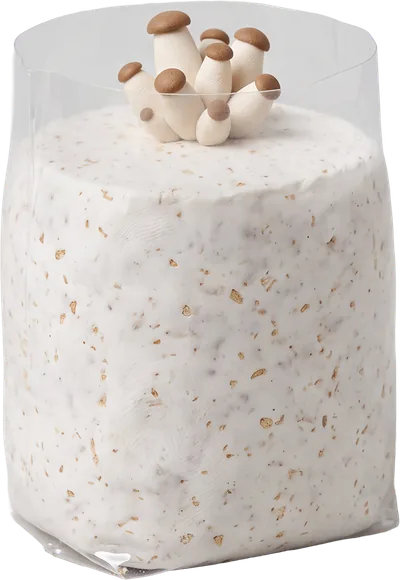
| Fruiting | King oyster |
|---|---|
| Temperature | 54 to 64 °F (12 to 18 °C) |
| Humidity | 90 to 95% relative humidity |
| Fresh air | CO2 under 2,000 ppm |
| Light | 12 hours a day |
A cooler room than the other oysters. Out-Grow says growers used to warm-fruiting oysters often keep king too warm, and "the blocks simply will not pin above 64 °F" (18 °C) (Out-Grow).
More CO2 while the stem grows. King wants more CO2 than other oysters while pins form and stems lengthen (keep the bag top mostly closed), then more fresh air; too much CO2 for too long gives thin stems and small caps. North Spore allows king twice the CO2 it allows blue oyster. In a 2019 study of two Korean bottle farms, the one that held CO2 mostly under 2,000 ppm grew thicker stems, bigger caps and heavier mushrooms, 125 g against 102 g on average; the other raised CO2 to 3,500 to 4,500 ppm on purpose while pins formed, then aired the room after thinning.
Each condition is explained in Mycology 104: environmental control and fruiting, and fruiting chamber designs shows ways to hold them.
When to harvest king oyster mushrooms
Harvest when When fruit is still firm and go=rowth has slowed down..
Sources judge king by its stem and its cap together. Out-Grow picks while the caps are no wider than 1 to 2 in (2.5 to 5 cm); GroCycle lets stems grow up to 8 in (20 cm) long. Why the cue matters is in when to harvest oyster mushrooms.
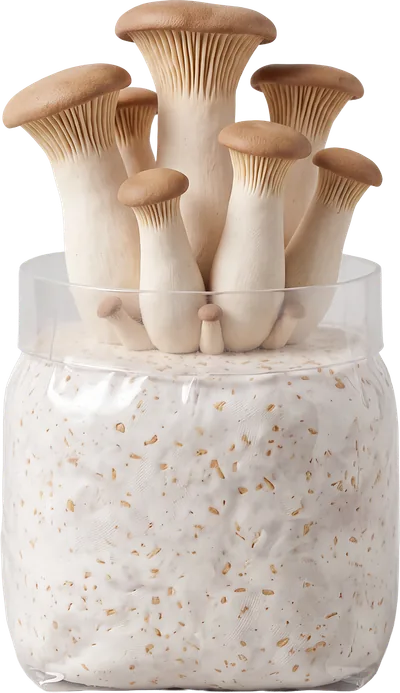
Ready to pick
- Caps not yet flat: pick before they flatten.
- Thick, firm stems.
After the harvest
On the calendar above, the next flush is ready about 14 days after a harvest. A block gives 1 to 2 flushes worth picking. Sources differ on the second: North Spore notes king trumpets "do not reliably produce second flushes", and Mycelia writes that most growers pick one flush and then discard the substrate, to head off bacterial infection, while grower guides count two or three (North Spore, Mycelia, GroCycle).
A fresh harvest keeps about 7 days. It is one of the better keepers among oysters: about a week in a plain fridge (4 to 7 days in two sources), in a paper or perforated bag.
In MycoQR, a new yield tray (the harvests you combine to sell) suggests a best-by date about 7 days out, and the Fresh Sheet marks a tray that is past it: mushroom farm inventory and invoicing.
Storing cultures and spawn
On the cultivation team's answers, cold storage extends the life of king oyster plates, liquid culture, grain spawn and colonized blocks, and does nothing for spores. The days below are the team's. Storing cultures is in Mycology 102: sterile technique and culture work.
| Finished | Room temperature | Cold storage |
|---|---|---|
| Agar plates | about 30 days | about 90 days |
| Liquid culture | about 60 days | about 120 days |
| Grain spawn | about 30 days | about 60 days |
| Colonized blocks | about 30 days | about 60 days |
What goes wrong
No pins. A room too warm (above), CO2 too high, or a block not yet fully colonized. North Spore suggests eight hours in the fridge, still in its bag, for a block slow to pin.
Pins that stall or dry. The humidity swung or dropped, or a draft hit the top of the block. Keep the air steady and very humid: GroCycle keeps the bag at 95 to 100% while pins form, then the table's range.
Thin stems, small caps. Too much CO2 for too long; give more fresh air once the stems are up.
Wide, flat caps on short stems. Out-Grow ties it to too much fresh air too early, before the stems have grown.
Dark or brown wet spots on the caps. Often bacterial blotch, which GroCycle notes king is prone to. The spots follow water sitting on the caps: mist the air, not the mushroom, and move the air in the last days before picking. Some strains resist it better (above).
Spores in the room. King drops less spore than the other oysters: North Spore puts it down to its short gills. NCAT notes that oysters "can release high volumes of spores during fruiting, which may cause respiratory irritation in enclosed or poorly ventilated indoor environments," and that "Proper ventilation or use of a respirator is recommended for indoor growers producing at scale" (NCAT). More is in spores in the grow room.
Common Fruiting Problems shows each of these, and the contamination guide covers molds and bacteria.
Questions
Is king trumpet the same as king oyster?
Yes. Both names are sold for Pleurotus eryngii. North Spore's Black King is a different mushroom, a hybrid of oyster and king trumpet.
Should you grow king oyster in bags or bottles?
The US guides grow it in bags, fruited from the top; large farms in Korea and China use bottles, fruited from the mouth, and thin the pins to three or four a bottle, Mycelia writes, so each grows a thick stem under a small cap. The US guides don't mention thinning. This page follows bags, opened at the top.
How many flushes does a king oyster block give?
A block gives 1 to 2 flushes worth picking. A second isn't sure, and many growers stop at one.
How long do king oyster mushrooms take to grow?
It takes about 56 days from a new culture to the first harvest, or about 42 days from the grain spawn, on the days MycoQR's cultivation team set. Counted from the day the block is inoculated, the first harvest comes on about day 28.
Is king oyster easy to grow?
Begginer to intermediate friendly.Alonger fruiting variety. King oyster is forgiving in its harvest timing, it is both slow to fruit & minimal in spores.Sources
Read in November 2026. The days in the grow calendar and the storage table, and any card fact marked as the team's, are MycoQR's cultivation team's.
- NCAT: Mushroom Cultivation
- Ohio State: Gourmet oyster mushroom varieties
- SARE, grant report: Organic king oyster trials on a New York farm (FNE06-584)
- Kim et al. 2019, two king oyster bottle farms measured day by day (Korean, English abstract): Journal of Mushroom
- Moon et al. 2020, growing temperature and the shelf life of king oyster (Korean, English abstract): Journal of Mushroom
- Lee et al. 2012, trimming and storage temperature for king oyster (Korean, English abstract): Journal of Mushroom Science and Production
- Ye et al. 2021, how king oyster forms its pins: Genes
- Guo et al. 2023, storing king oyster after harvest (a review): Foods
- Rodriguez Estrada and Royse 2007, supplements and blotch resistance in king oyster (abstract): Bioresource Technology
- Kirbag and Akyuz 2008, king oyster on straw and other farm residues (abstract): Journal of Food, Agriculture and Environment
- North Spore, spawn: Organic king trumpet grain spawn
- North Spore, booklet: fruiting block instructions
- Field & Forest, spawn: King oyster grain spawn
- Mycelia, strain sheets for Pleurotus eryngii: M2600, M2603, M2604
- Mycelia, blog: How to grow Pleurotus eryngii, cardoncello
- Mushroom Mountain: King oyster (Pleurotus eryngii); Which oyster mushroom should I choose to cultivate
- GroCycle: How to grow king oyster mushrooms
- Out-Grow: How to grow king oyster mushrooms (Pleurotus eryngii)
- Zombie Mushrooms: How to grow king oyster mushrooms at home
- Caley Brothers: King oyster kit instructions
- Bootstrap Bee: Why your king oyster isn't fruiting
- Epic Gardening: King trumpet mushrooms
Related guides
How to Grow Oyster Mushrooms
How to grow oyster mushrooms: seven types compared day by day, straw or sawdust, fruiting conditions, when to harvest, and what goes wrong.
How to Grow Phoenix Oyster Mushrooms
How to grow phoenix oyster mushrooms (Pleurotus pulmonarius), also sold as Italian or lung oyster, day by day: growing conditions and harvest.
Common Fruiting Problems and How to Fix Them
Diagnose and fix the most common fruiting problems: no pins, aborting pins, long stems, fuzzy feet, overlay, cracked caps and bacterial blotch.